
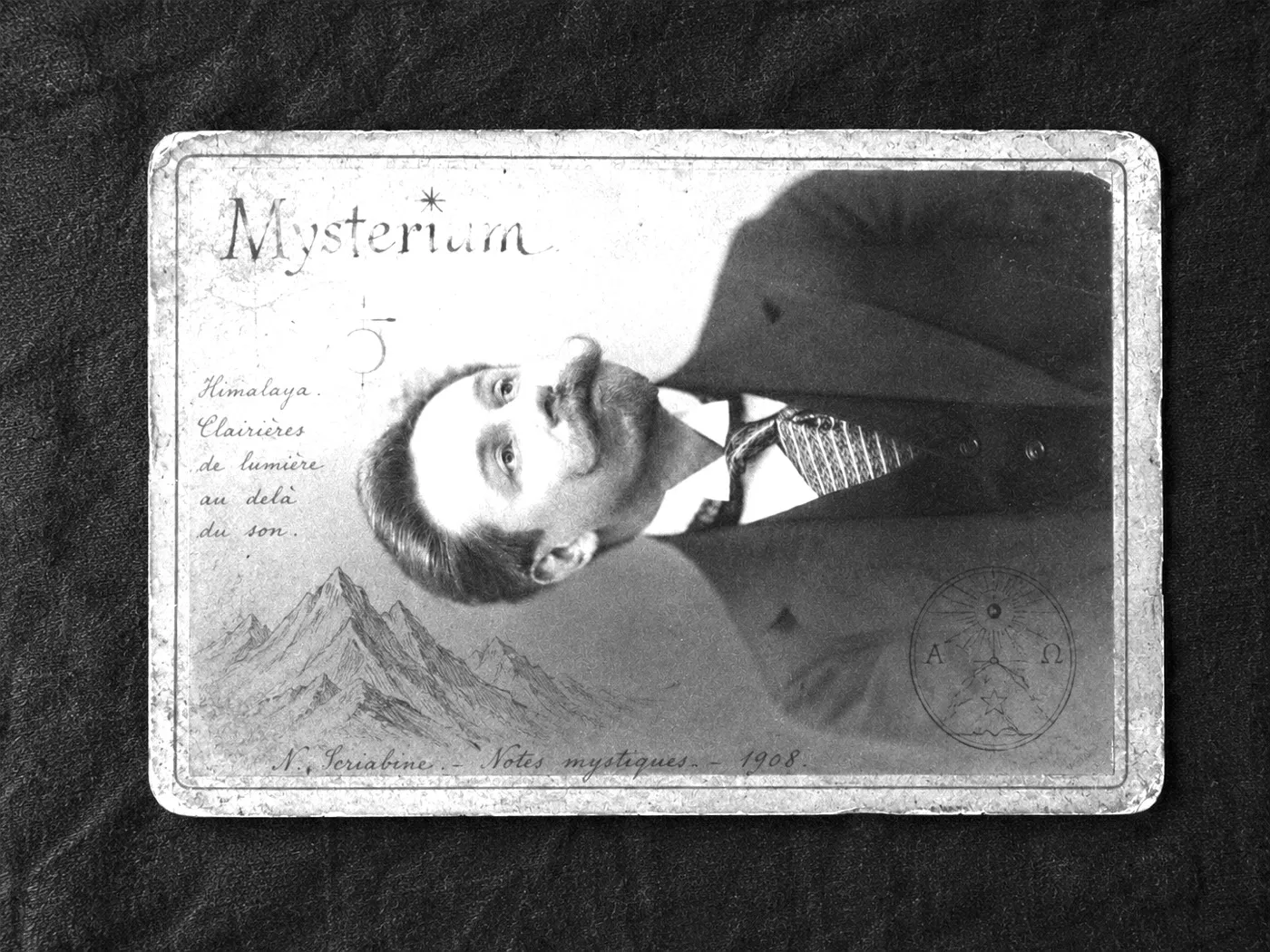
Alexander Nikolayevich Scriabin, born on Christmas Day of the year 1871 in Moscow, bore a secret in his breast — a mystery, as it were, trans se ipsum, a secret of his own day-after-tomorrow, a mystery of posthumous need.
Now this secret of Scriabin’s bears not primarily upon his remarkable day of birth — which he read, with all due unpretentiousness, as the sign of his election; nor upon his colour-synaesthesia, which allowed Scriabin to perceive the several keys each as invested with a colour; nor even upon the often surreal-seeming genius of, say, his ten piano sonatas or the Poème-Nocturne; but upon the paradoxical unavailability of Scriabin’s last, admittedly unfinished work, the Mysterium. Paradoxically unavailable because this work had to fail itself in order one day to be able to succeed.
Scriabin intended the said Mysterium as a messianic Gesamtkunstwerk which, as a symphony of the senses, was to encompass tones, scents, colours, effects of light and mist, dance and moving architecture. Conceived for a total playing time of seven days, the Mysterium was, with the support of hundreds of participants, to be performed without cease in a cathedral in the Himalayas until the whole of humanity had attended it and, in the course of a collective ecstasy, had passed through a musical-mystical catharsis. The aim was thereby to raise humanity into a higher state of transcendent unity. What was already latent in Scriabin’s earlier works — such as Le Poème de l’Extase, Prométhée or Vers la flamme — was in the Mysterium to attain an incommensurable heightening, indeed to realise the sacred artwork non plus ultra.
Scriabin himself understood himself here as a redeemer-figure in the service of God, called to create the Mysterium for the salvation, sanctification and heightening of humanity. Owing to his relatively early death in April 1915 — Scriabin was forty-three — only seventy-two sketched pages of the L’acte préalable of the Mysterium lay ready at the time of his death. From these sketches the Russian composer Alexander Nemtin later reconstructed, over a span of twenty-eight years, the possible further unfolding of the Mysterium, which in 1973 was given its première as Preparation for the Final Mystery (Part 1: Universe, Part 2: Mankind, Part 3: Transfiguration) and has since stood as Scriabin’s Mysterium. The playing time of the Nemtin version, some two hours and forty minutes, is considerable — yet, against the 168 hours potentially envisaged for the entire Mysterium, only a fracture.
But wherein lies Scriabin’s secret of his own day-after-tomorrow? It lies in the very primordial moment of the Mysterium — namely, in the need of the apocalyptic, toward which the Mysterium was to be created. Apocalypse means, in its originary sense, ‘unveiling’ (from the Ancient Greek ἀποκάλυψις, apokalypsis: unveiling, disclosure or revelation); it thus marks the epistemic moment of the unconcealment of truth as such — yet understood out of that principial need, for which only the lifting of the veil of the worldliness of world can bring the salvation that is due.
Truth in the apocalyptic sense is therefore always already beyond itself, is trans se ipsum, for it realises itself only ever from the end of all things. Truth is ‘eschatological’ (from the Ancient Greek τὰ ἔσχατα, ta éschata: the uttermost things, the last things), for its irrefutability proves itself only in the Last. This holds, moreover, for Christ as well, who as the Anointed of God can fully disclose and verify himself only at his second coming, τὰ ἔσχατα.
I am nothing, I am play, I am freedom, I am life, I am a boundary, I am a summit, I am God.
The paradoxical unavailability of the Mysterium thus lay always already in its soteriological orientation, which — even granting Scriabin’s actual messianic election — will make itself possible only out of that need which transcends the work of the Mysterium into a salvation necessarily greater than any intention to evoke it. For it grows not merely out of the principial need, but comes to pass, in the first place, only from a temporally a-linear completion. The Mysterium thus had not only to fail in order to succeed posthumously, but in order to be able to be made possible from the end of every possible un-need.
Is everything thereby already said of Scriabin’s secret? No — for in the apocalyptic need it is intimated to us according to what necessity of the poietic the Mysterium is to be realised. ‘Poiesis’ denotes making (from the Ancient Greek ποίησις, poiesis: making, producing, fashioning) — that is, the force that gives birth and generates within the work. The Mysterium was thus laid out so as to turn from need (Not) into a Notwendigkeit — a necessity that, in German, literally spells the turning (wenden) of need — which will make this turning-need into the poetry of the movement.
Scriabin’s poetry lay here in the flexion into the hope of music — more concretely, in a soteric synpoesy of unveiling sound: that is, a con-densation-together and con-densation-with of apocalyptic tonality (from the Ancient Greek σύν-, syn-: together and with).
The marks of this Scriabinian synpoesy are, on the one hand, the paradox that withdraws from the purely conceivable; on the other, the necessity of musically poeticising all that is inconceivable — for music makes music of itself, just as poetry poetises itself. Further, its progressivity into the open, for Scriabin’s music creates in the free and the spontaneous, yet toward the one — albeit unavailable — telos of redemption. This incompleteness then completes itself in the adequate paradox of the fragment. The nearness to the Universalpoesie of Schlegel and Novalis sounds unmistakably through.
Scriabin’s Mysterium was thus never laid out to be completed, for the apocalypse will create itself only in the breach of possible impossibility. The last time of becoming was and is the un-becoming in the fragment, which challenges us, the afflicted, to co-poetise, co-hear and co-compose within it — exactly as Scriabin’s collective ecstasy also foresaw. The Mysterium was and will thus only ever be a summons to us all to mysticise ourselves; it has, in the last, a theotic character, for it wills the deification of all (from the Ancient Greek Θέωσις, Theosis: divinisation, deification) who will be exposed to it.
We reckon Scriabin’s secret, then, wholly to the noblesse rebelle, for the nobility of the apocalypse revolts, in his œuvre, in poetic freedom; and the revolt of the divine ennobles therein the insurrection against all that is unapocalyptic, un-soteric, amystical and un-theotic. Scriabin’s soteric synpoesy, in the twice-fraught chord of the apocalypse, was his noblesse rebelle — which could fulfil itself only in so far as it will have been able to have fulfilled itself.
Scriabin is one of us who have destiny in view. He is, with Christ, in our very midst, where his redeeming co-poetry sounds through our spheres — from his Préludes, by way of his Third Symphony, Le Poème Divin, to the unsayability of the Mysterium.
EXPLICIT